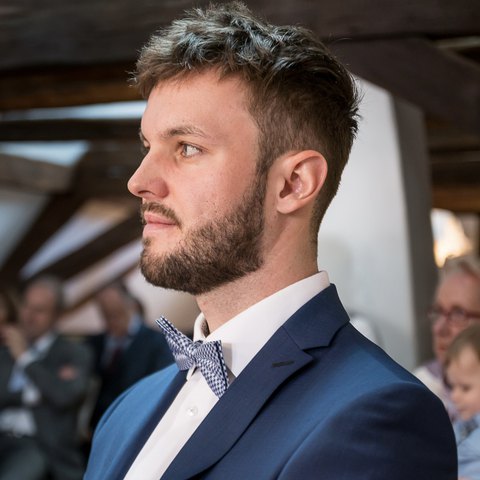
About
I'm a physicist working at the intersection of two fields that famously nobody understands: quantum computing and machine learning. Since May 2024 I've been a doctoral researcher at the German Cancer Research Center (DKFZ), or more precisely at the Helmholtz Institute for Translational Oncology (HI-TRON) in Mainz under the supervision of Niels Halama.
Immunotherapy has been skyrocketing for a decade now: more funding, more trials, more patients it genuinely helps. Predicting which of them it will help has not kept up. Give the same immunotherapy to two patients with the same diagnosis, and one of them gets dramatically better while the other barely responds at all, but why? Nobody can reliably say in advance which is which, so both get much the same plan. The answer is hiding somewhere in the data: in tumours, immune cells and genes. Unfortunately, it does an exceptionally great job at hiding. I am passionate about building models that go looking for it, while keeping them honest when they'd rather report a pattern that isn't there.
Machine Learning
Machine learning is what you reach for when a problem clearly has a rule but nobody can write it down. Rather than stating the rule, you show a model a great many examples and let it fit one for itself. Given enough annotated tumours, it will settle on a boundary that no pathologist could put into words.
The catch in my field is that biological data is wide and short: tens of thousands of measurements per patient, and only a few hundred patients to learn from. A model then has far more freedom than it has evidence, and the difficult part is no longer fitting the data but working out whether the fit means anything at all.
Quantum Machine Learning
A classical bit is a decisive little thing: 0 or 1, pick one. A qubit refuses to commit until you ask it directly, and it can be entangled with other qubits, so asking one of them tells you something about the other. Physicists have spent a century arguing about what that actually means, and engineers have spent thirty years trying to build one that survives longer than a millisecond.
Quantum machine learning asks the obvious follow-up question: given these strange machines, can we learn anything with them? It turns out that most of the classical toolbox has a quantum cousin by now: there are quantum kernels standing in for support vector machines, variational circuits playing the role of neural networks, quantum versions of generative models, and quite a few ideas that don't have a classical counterpart at all. My own favourites are the quantum kernels.
Does it beat classical machine learning? Sometimes, on some problems, if you squint and choose your dataset carefully, which is the polite way of saying that nobody knows yet.
My work
Publications
-
Quantum-Enhanced Kernel Alignment for Imbalanced Biomedical Data Classification
In preparation
Conference contributions
-
Quantum computing for personalized medicine: advances in quantum
kernel utilization for machine learning
HI-TRON Symposium 2026 Talk -
Quantum Computing in Oncology
HI-TRON Symposium 2025 Talk -
Quantum Kernel Alignment for Clinical Data Classification
HAICON 2026 Poster -
Imbalanced Classification with Quantum Kernel Methods
QTML 2025 Poster
Awards
-
Best Poster Award
Quantum Machine Learning physics school (DPG), Physikzentrum Bad Honnef 2026